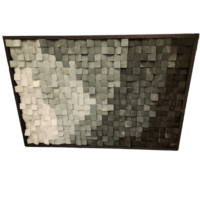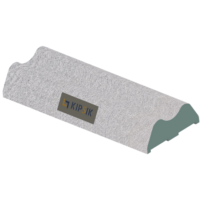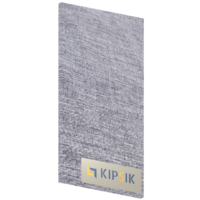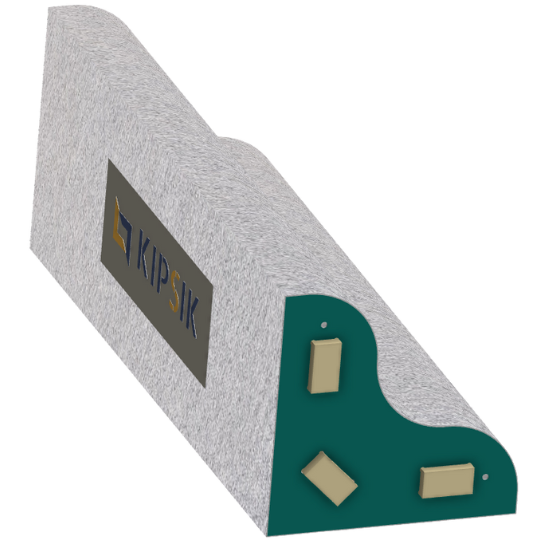
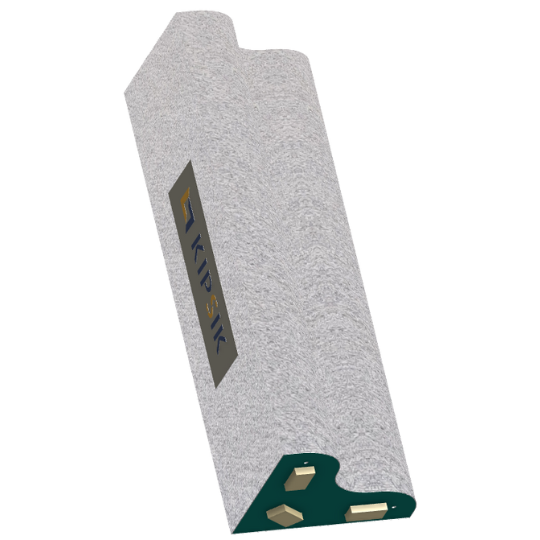
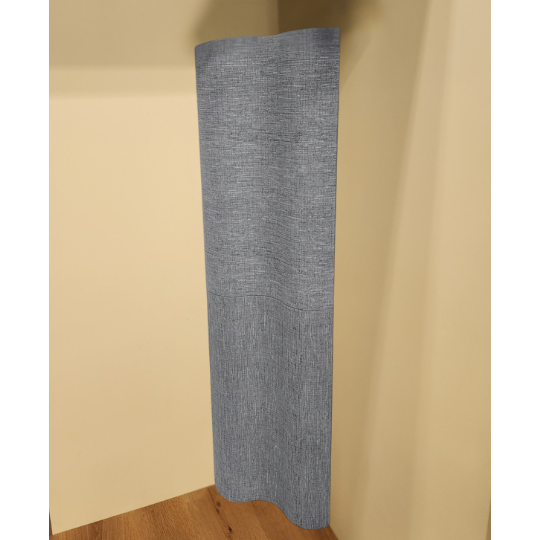


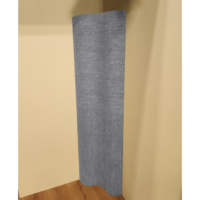


A membrane bass trap absorbs low-frequency sound waves that hit its surface. They are usually placed in multiples in the corners of a room (for example, as towers). Floor-to-ceiling bass traps improve the room’s acoustics. Acoustic sound reflectors and other absorbers attenuate surrounding sounds at various frequencies. The low-frequency sound absorption of the bass trap is influenced by the density of the membrane used and the size of the air gap behind the membrane. Product dimensions, mounting methods, technical specifications, and fabric choice can be customized according to requirements
Features. The product absorbs sound waves that hit it, reducing reverberation in the room while also enhancing the room visually. The greater the proportion of the walls and ceilings covered by sound-absorbing products, the more clearly the sound in the room can be distinguished
Usage. The product is intended for use in rooms with a normal relative humidity level – permanently no higher than 60%. Normal room temperature is recommended for installation
Installation and fastening
⇒ The product is attached to the walls or floor using screws or wall hooks
⇒ The product can be left unattached, as it stands on its own
⇒ Due to its size, it is recommended to attach the product from all corners in a way that withstands exposure to external influences
Dimensions. The cross-section of the product in the pictures is 0.5 x 0.5m. The maximum height of the product can be up to 3.0m – take into account the transportability to the installation site. The installation can consist of one or more products.
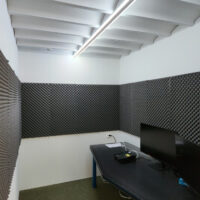
Sound insulation. A good result is achieved when the acoustic wall and ceiling cover at least two full areas of the room by 80%. Acoustic measurements of a 3x1m gypsum mini-room showed that the sound echo is up to 0.14 seconds, which, according to Akukon’s explanations, is less than is usually the case in bedrooms (0.5 seconds at low frequencies). The placement of bass traps in room corners affects low-frequency sounds — from 50 Hz upwards
Storage. Products should be stored upright and on a smooth surface. Protect products from moisture
Transport
⇒ The product must be carried correctly supported and carefully – high tensile pressure can damage the product.
⇒ If there is a risk that the product will be damaged during transport, additional covers or additional fastenings must be used
⇒ It is recommended to transport long parts in pairs and with two hands
⇒ The packaging and fastening tape are removed immediately before installation
Bass trap, manufacturing information
⇒ Bass trap size and attachment point locations according to customer information
⇒ Inside the bass trap, at the center of the flat surfaces at the top and bottom edges, there are four OSB mounting points
⇒ CNC-cut components and auxiliary parts to obtain the desired shape during gluing
⇒ PUR glue D4, 1-component, adheres well to the cut plaster edge
⇒ Contact adhesive for gluing fabric to lower surfaces
Layers of the membrane bass trap, adjustable according to requirements:
⇒ Cover fabric material and colour according to requirements
⇒ Multi-layer membrane cover – thickness 3.4 mm; density 500 kg/m³; elasticity (Young’s modulus) 100 MPa, airtight
⇒ Air gap – thickness 80 mm; density 1.2 kg/m³; elasticity (Young’s modulus) 142 kPa
⇒ Rockwool – thickness 30–175 mm; density 30 kg/m³; elasticity (Young’s modulus) 50 kPa, flow resistivity (σ) 20 kPa·s/m²
⇒ Air gap – thickness 12.5 mm; density 1.2 kg/m³; elasticity (Young’s modulus) 142 kPa
⇒ Hard gypsum enclosure – thickness 12.5 mm; density 904 kg/m³; elasticity (Young’s modulus) 3 GPa, airtight
| Weight | 21 kg |
|---|---|
| Dimensions | 450 × 450 × 950 mm |
| Plasterboard | hard plaster (11 kg/m2), standard plaster (8.1 kg/m2) |
| Finish | fabric |
| Sound | 80Hz |
| Fire | 15 min |
| Materials | membrane fabric, OSB, rock wool |
| Author | Kipsik |
| Manufacturer | Kipsik OÜ |
| Origin | Estonia |