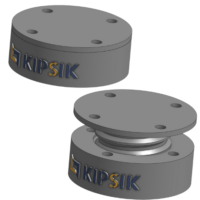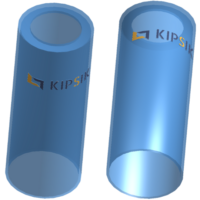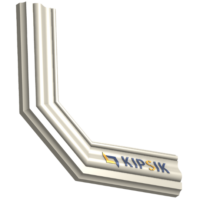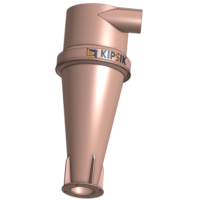


Cyclone separator, for workbench. Grinding, sawing and milling dry materials produces fine dust, which quickly clogs vacuum filters. Cyclone separators are the most effective dust collection devices, separating dust particles into the collector before the filter. The product must be attached to the lid of a hermetically sealed container and connected between the workbench and the vacuum cleaner. The separation of larger particles is carried out using centrifugal force, significantly reducing the amount of dust before it reaches the vacuum cleaner filter. The separator can be with or without a thread. The product can be printed with a large-scale 3D printer. The product can be modified according to the customer’s instructions
Use. In a pre-container connected to the vacuum cleaner
Color and material. According to the 3D printing material used, usually PLA
Flexibility of 3D printing. The ability to choose the preferred material, determine the size and connection methods yourself, in addition to making changes to the general parameters of the printed product and testing different combinations. In summary, it provides several advantages compared to purchasing a ready-made solution. It is advisable to use freely available calculators when planning the general data of the product and take into account the printing area of the 3D printer
3D printing data. Our equipment allows printing parts up to 420x300x400mm
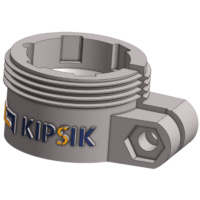
Edge and thread. There is a groove for a gasket on the edge of the lower part of the separator, the upper part is 3mm wider than the lower part, which allows it to be made more hermetic with a 3x30mm PE gasket. Threading can be used instead of using a gasket. Both connection methods allow the separator to be disassembled for cleaning the interior
Product dimensions. Width 215mm, height 540mm. Average wall thickness 3mm
Cyclone separator, data:
⇒ Density 1250 kg/m³
⇒ Weight approx. 1.6kg
⇒ Number of components 2-4 parts
⇒ Waterproof, washable
| Weight | 1.6 kg |
|---|---|
| Dimensions | 540 × 215 × 215 mm |
| Finish | none |
| Materials | PLA |
| Author | Kipsik |
| Manufacturer | Kipsik OÜ |
| Origin | Estonia |